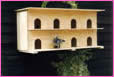
Artificial Breeding FacilitiesThe provision of pigeon lofts and other types of artificial breeding facilities are becoming a more common sight in European towns and cities. Pigeon lofts and nest boxes can be provided on buildings where pigeon-related problems are being experienced. Dovecotes are normally provided in public areas, where the feeding of pigeons is already taking place, and in tandem with a designated feeding area. Nest boxes and lofts Pigeon nest boxes or lofts that are to be used as part of a control operation can be as basic or as ornamental as the site requires. A pigeon will nest in almost any receptacle that offers even partial protection from the elements. The birds will use a basic open fronted box made of plywood just as readily as an ornate box pictured on the accompanying sheet. The size of the box or loft is limited only to the size of the site available. In many respects a pigeon loft (approx. the size of a garden shed) will be the best option as this will accommodate more birds and can be more easily visited and cleaned. The more birds using the loft to roost will mean that there will be correspondingly fewer droppings on the buildings in adjacent areas. Nest boxes can be sited in a variety of different places but ideally should be sited near to or on existing nesting or perching/roosting sites. Prime sites would be on the roof areas of buildings where there is easy access. Boxes should be sited off the ground wherever possible and the optimum height would be approx. 5 feet above ground bearing in mind that access to all parts of the box will be required for egg collection and cleaning. A tray with gravel or sand in it can be placed below a wall-mounted box to collect droppings and then this can be easily cleaned. Boxes and lofts can be finished with a weatherproof non-toxic preservative that will blend in with any surrounding. There are a wide variety of colours available and these will ensure that the boxes are almost invisible to the naked eye at ground level. Designs can be altered to suit the requirements of the site. Birds may need to be encouraged to use the boxes particularly if they are sited away from their feeding/roosting places. Offering food for a week or two can easily do this and, as pigeons are curious by nature it will not take them long to see the potential of the nesting site. No bedding or nesting materials need be provided to encourage the birds to start nesting. Further information on the provision of nest boxes and lofts can be found on the Area-wide Controls page. Dovecotes Artificial nesting sites for pigeons can be almost any shape or size and one of the most attractive is undoubtedly the dovecote. Dovecotes have been used to house pigeons for centuries and can vary dramatically in terms of their construction and the materials used to build them. Examples from the 17th, 18th and 19th centuries are not only intricate in terms of their architecture, but some are extremely large and in many cases are considerably larger than the average 4 bedroom house. The familiar white octagonal dovecote is a more common sight in the 21st century, built to house 6-8 pairs of birds and constructed from wood or ply. For areas such as public parks, where pigeons are often fed regularly by the public, a dovecote is probably the most effective method of drawing birds to feed, roost and nest in one localised area and by so doing reducing random perching, nesting and fouling elsewhere. Scientific research has proved that if pigeons are drawn to an artificial breeding facility and can be encouraged to nest within it, then by removing eggs as laid, the size of a flock of pigeons can be reduced by at least 50% without causing any harm or distress to the birds. If a designated feeding area is provided adjacent to the cote, where the public can legitimately feed pigeons but where excess food can be easily removed, birds will be further encouraged to use the cote. The cote is an alternative to the nesting box or the loft and can be made to be an attractive feature of any town or city centre. A number of local authorities in the UK are now in the process of considering the provision of dovecote type facilities in public areas in an effort to reduce pigeon numbers humanely and effectively. Two large NHS hospitals in the UK (Nottingham and Cardiff) are also building impressive dovecotes in the hospital grounds in an attempt to draw pigeons away from roosting and nesting on hospital buildings. The dovecote is the way forward for large scale pigeon control in the 21st century and if provided as a complimentary control option, alongside a hard hitting public information campaign designed to reduce general public feeding, pigeon numbers will reduce dramatically in any given area. The dovecote is a popular concept with the general public and not only relatively inexpensive to build and maintain but a method of control that will permanently reduce pigeon numbers. PiCAS will provide detailed technical drawings, on request, to those that wish to build a facility of this nature. PiCAS will also recommend a company that will build and erect a dovecote of any size or dimension to PiCAS specifications. Further information on dovecotes and artificial breeding facilities can be found on the Area-wide Controls page.
|